NC LLC AGENTS INC. / NORTH CAROLINA BUSINESS GUIDE
What the law actually requires, what your agent receives, why the address matters, and the costly mistakes business owners can avoid.
Updated November 10, 2026 · For LLCs, corporations, and other registered entities
Required continuously
For North Carolina LLCs, corporations, and other covered registered entities
Physical NC registered office
Not merely a P.O. Box or generic virtual mailbox
Legal notices, not everyday mail
Registered agent service is different from a virtual office
THE ESSENTIAL ANSWER
Think of a registered agent as your company’s official legal contact point.
When someone needs to formally deliver a lawsuit, legal papers, or another document that the law permits to be served on your company, there must be a dependable place to send or deliver it. That is the purpose of a registered agent and its registered office.
North Carolina’s legal definition, in plain English
A covered business must keep a registered agent and a registered office in North Carolina. The agent’s statutory duty to the company is to forward any notice, process, or demand served on the agent to the company at its last known address. See N.C.G.S. § 55D-30.
You can usually be your own agent if you qualify, or appoint a professional service. Either way, choosing the agent does not shift the company’s responsibility to meet its filing, tax, licensing, and legal deadlines.
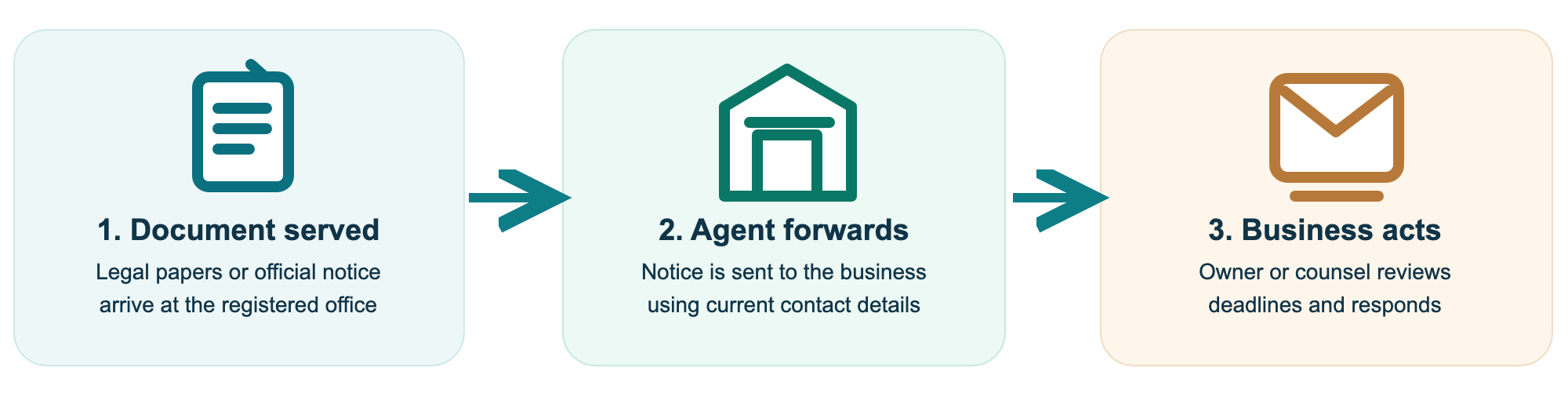
GRAPHIC 01 / HOW IT WORKS
One legal notice. Three important steps.
The agent is the delivery point, not the company lawyer, accountant, or compliance officer. Receiving a paper is only the start: the business must actually review and act on it.
1. Lawsuits and summonses
Service of process may include a summons, complaint, subpoena, or other court papers. Response deadlines can be strict.
2. Official notices
Certain state notices and other legally authorized demands may be delivered through the registered agent.
3. Prompt forwarding
Your agent needs accurate contact details. The company must monitor the forwarded messages and act promptly.
THE LEGAL REQUIREMENTS
Who needs a registered agent in North Carolina?
Under N.C.G.S. § 55D-30, covered North Carolina entities include LLCs, business corporations, nonprofit corporations, limited partnerships, and limited liability partnerships, plus corresponding foreign entities registered or authorized to do business here.
Single-member and multi-member LLCs follow the same registered-agent rule. The number of owners does not eliminate the requirement. An ordinary sole proprietorship that is not organized as one of these entities generally does not need an agent simply because it operates a business.
An out-of-state business that is required to register in North Carolina typically needs a North Carolina registered agent in addition to maintaining whatever agent is required in its home jurisdiction. Not every sale to an NC customer automatically means foreign registration is required; the facts and statutory exceptions matter.
Who may serve as the agent?
- A North Carolina resident whose business office is the registered office.
- An eligible NC corporation, nonprofit, or LLC with a business office at that address.
- An eligible foreign corporation, nonprofit, or LLC authorized in North Carolina and with a matching business office address.
The agent must agree to the role. The registered office must have a physical street address in North Carolina; a P.O. Box by itself is not enough. The state allows a separate registered mailing address, which may be a P.O. Box, but that does not replace the street address.
Business-hours reality: North Carolina law requires a physical registered office where service can be received; for an individual agent, that address must be the individual’s business office. Reliable availability during ordinary delivery/business hours is a practical reason many owners appoint a professional service, even though the statute does not prescribe a universal 9:00 a.m.–5:00 p.m. schedule.
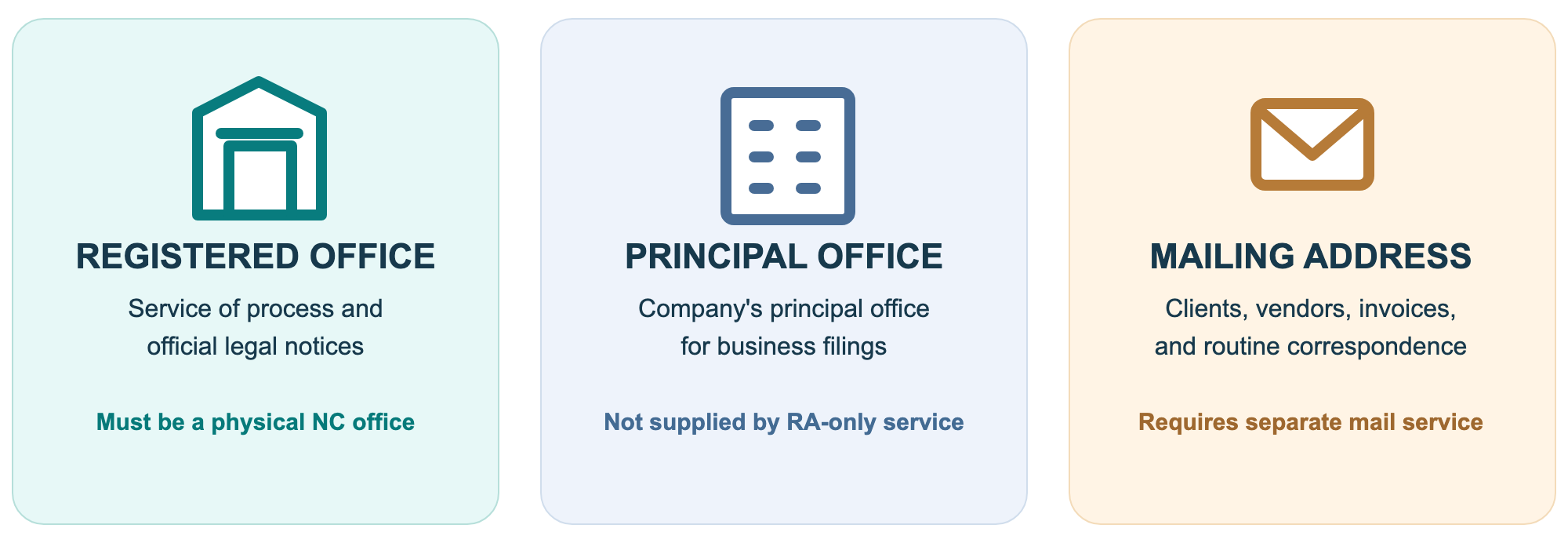
GRAPHIC 02 / AVOID THE ADDRESS TRAP
Registered office, principal office, and mailing address are not the same thing.
A company can have several addresses because each one serves a different purpose. The address a registered-agent company gives you is not automatically yours to use everywhere.
Which address can you use with NC LLC Agents Inc.?
| Address use | Registered Agent service | Virtual Office service |
|---|---|---|
| Registered office on NC Secretary of State records | Yes | Yes, when set up appropriately |
| Service of process and official notices | Yes | Yes, if appointed as RA |
| General business mail and vendor correspondence | No | Yes, subject to service terms |
| IRS/EIN, banking, and business mailing address | No | Permitted under VO terms; institution decides acceptance |
| Google Business Profile address | No | Only if you independently meet Google’s eligibility rules |
| Personal residency, DMV, or utility address | No | No |
The provider-specific distinctions above are based on NC LLC Agents’ published service descriptions. A virtual office is not proof of a physical business location for every license, bank, or listing platform.
What about privacy?
Hiring an agent lets you list the agent’s registered office on the registered-agent portion of public state filings rather than using your home address there. It does not guarantee that your home address will be absent from every other public filing, real-estate record, permit, business listing, or data-broker record. Review every field before filing.
SELECTING THE RIGHT SETUP
Can you be your own registered agent?
Yes, if you satisfy North Carolina’s eligibility and registered-office rules. Owners often choose themselves to avoid a service fee. But they should consider the public address, daily availability, travel, relocation, and the risk of overlooked legal paperwork.
Option A: Serve as your own agent
- No third-party subscription fee
- You control initial receipt of documents
- Your qualifying address appears on the state’s registered-agent record
- You must keep the office available and update filings when details change
Often suitable for: Owners with a stable NC business office, predictable availability, and comfort with public contact information.
Option B: Hire a professional service
- A designated North Carolina registered office
- Agent receives covered notices on your company’s behalf
- Can help keep your home address off the RA portion of the record
- Works for many owners who travel or operate outside North Carolina
Often suitable for: Home-based businesses, remote owners, multi-entity operators, and owners who do not want legal service at home.
What to ask before hiring: Is the company an eligible registered agent? How does it notify you when documents arrive? What are the escalation procedures for time-sensitive process? Are scanning and forwarding included? What is the renewal cost? Can you use its address for any other purpose? Does it have a clear cancellation and change-of-agent process?
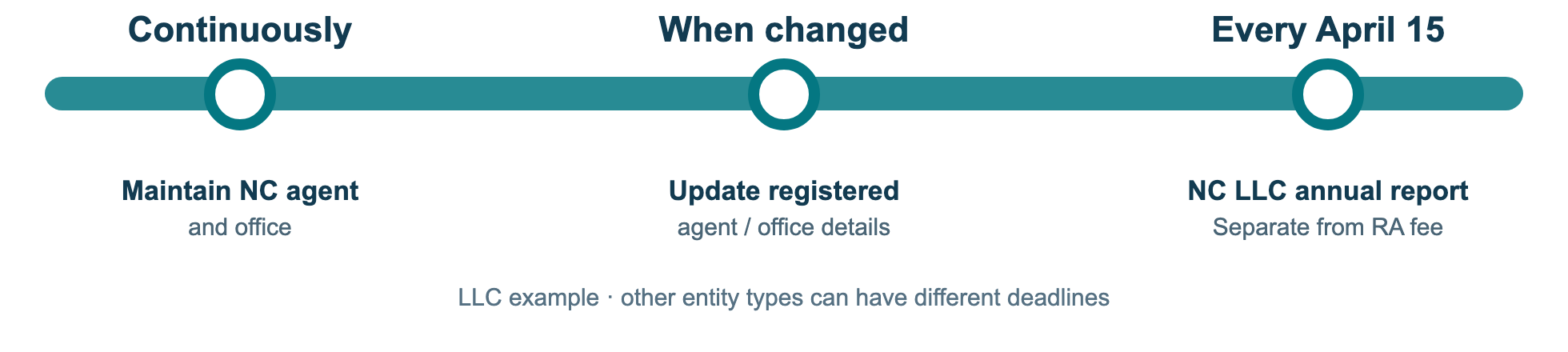
GRAPHIC 03 / STAYING COMPLIANT
A registered agent is mandatory. Annual reports are a separate obligation.
A registered-agent subscription does not replace the North Carolina Secretary of State annual report, tax returns, franchise or income taxes that may apply, permits, licenses, or other regulatory filings. Your business remains responsible for all of these.
April 15
Annual report due date for North Carolina LLCs
The first report is due April 15 in the calendar year after formation, then annually. The state currently lists a $200 paper filing fee and a $203 online credit-card total (including the $3 electronic payment fee). ACH electronic payment currently adds $2 instead.
Corporations and other entity types have different reporting rules. See the state’s current fee and due-date chart.
Every day
Maintain the correct registered agent and physical NC registered-office information. Keep your agent informed of the best company contact information.
When changes happen
Report a change in registered agent or registered office properly. The NC Secretary of State identifies a 60-day updating obligation, and the law provides change procedures.
Every reporting cycle
Check annual-report deadlines, tax obligations, business licenses, and other entity-specific rules. Do not assume any of these are included in basic RA service.
What if the registered agent resigns or the company changes address?
A business may change its agent or registered office by submitting a statement of change with the required information and the new agent’s written consent. North Carolina’s current fee schedule lists $5 for an LLC statement changing the registered agent and/or office. Certain changes also can be made through an eligible annual-report filing.
Under N.C.G.S. § 57D-6-06, an LLC’s absence of an NC registered agent or office for 60 days or more, failure to timely report specified changes, or failure to file its annual report within the statutory period can be grounds for administrative dissolution. The statute provides notice and an opportunity to correct the problem; dissolution is not automatic on the first missed day.
Important: When an entity lacks a reachable agent, North Carolina law can allow service on the Secretary of State in certain situations. That means failing to maintain an agent does not necessarily prevent a lawsuit or stop legal deadlines. See N.C.G.S. § 55D-33.
PROBLEMS WORTH AVOIDING
Six registered-agent mistakes that can create serious trouble
1. Using a P.O. Box as the office
A registered office requires a physical NC street address, even if a separate registered mailing address is allowed.
2. Putting the RA address on everything
RA-only service is not authorization to use that location for bank accounts, the IRS, packages, or ordinary business mail.
3. Ignoring forwarded notices
Someone may have legally served the company. A message left unread can mean a missed response date.
4. Forgetting the annual report
Paying an agent does not file your annual report. An LLC generally still has its April 15 state filing obligation.
5. Moving without updating records
Changing the agent, office, or company contact information without proper notice can break the delivery chain.
6. Assuming one agent covers every state
If a company must register in another state, it generally needs a qualifying registered agent in that state too.
REAL-WORLD EXAMPLES
How this works for different North Carolina businesses
A home-based single-member LLC
An owner in Huntersville uses a professional RA for the public registered-office record while retaining a different principal office or mail arrangement. The owner’s other public-record disclosures still need review.
Two owners forming a consulting LLC
Two Charlotte partners need one qualifying registered agent for their LLC, not one per member. Their annual report and tax obligations are separate from the RA subscription.
An out-of-state company expanding into NC
A Virginia corporation that must qualify in North Carolina appoints an eligible NC agent for its NC registration. Its original home-state agent typically remains in place.
Examples illustrate common scenarios, not conclusions about whether a particular company is required to register, which depend on its actual business activities and applicable law.
GRAPHIC 04 / OWNER CHECKLIST
Your registered-agent compliance checklist
- Appoint an eligible person or company that has agreed to serve.
- Confirm the physical registered office is in North Carolina.
- Use the agent’s name and address correctly on state filings.
- Give the agent current email, phone, and forwarding information.
- Have a process for promptly reviewing legal notices.
- Track annual reports, state taxes, licenses, and legal deadlines yourself.
- Update the Secretary of State promptly after relevant changes.
- Purchase a separate mail/address service if you need ordinary mail.
FREQUENTLY ASKED QUESTIONS
Registered-agent questions business owners ask most
Is a registered agent required for a North Carolina LLC?
Yes. North Carolina LLCs must continuously maintain an eligible registered agent and a registered office in the state. The same general requirement applies to other covered registered entities under N.C.G.S. § 55D-30.
Does a single-member LLC need one?
Yes. Being the only owner does not remove the registered-agent requirement. The owner can act as agent if eligible, or hire an agent.
Can I use my home address?
Potentially, if you are an eligible NC resident and the address meets the registered-office and business-office requirements. But it will appear in the registered-agent section of public filings, and you must consider availability for receiving service.
Can I use a P.O. Box or UPS Store mailbox?
Not as a substitute for the required physical NC registered office. The state may allow a separate registered mailing address, but that is different from the required street address.
Does a registered agent receive all my business mail?
No. The legal function covers service of process and covered notices, demands, and official correspondence. A provider’s registered-agent-only subscription should not be treated as general commercial mail handling. For regular mail, look at a virtual office or separate mailbox service.
Does registered-agent service include annual reports or taxes?
Not automatically. Annual reports, state filing fees, returns, tax payments, and industry licenses are separate obligations unless an additional service is explicitly purchased.
Will using an agent keep my home address private?
It can keep your home address out of the registered-office field when you use the provider’s address there. It does not guarantee complete anonymity or conceal addresses appearing in other filings and records.
Does my North Carolina agent cover other states?
Not necessarily. Every state has its own registered-agent rules. If your company is required to qualify in another state, it generally needs an agent that satisfies that state’s requirements.
Can I change my registered agent later?
Yes. North Carolina permits a statement of change with the required information and written consent of the new agent, and certain changes can be made through an eligible annual report. The state’s current fee schedule lists $5 for an LLC statement of change.
Does an agent represent me in court?
No. Being registered agent does not mean the agent is your attorney, can give legal advice, or will respond to a complaint on your behalf. Consult qualified counsel promptly when legal process arrives.
Is a registered agent the same as a virtual office?
No. The registered agent handles legal receipt and forwarding and provides the registered-office function. A virtual office is a separate address and mail-service product that may authorize broader uses, subject to its terms and outside eligibility rules.
STRAIGHTFORWARD NORTH CAROLINA COVERAGE
Need a registered agent without paying for a service you don’t need?
NC LLC Agents Inc. is based in Charlotte and serves businesses across North Carolina. Use our registered office for the state registered-agent record, receive notices through our team, and keep routine business mail separate unless you choose a Virtual Office plan.
Registered Agent · $98/year
Virtual Office for broader business address use is a separate $60/month service with a one-time $60 setup fee. State filing costs and optional services are separate. Confirm current terms before ordering.
Official sources and further reading
The article was checked against primary state sources as of November 10, 2026. For live filing requirements or prices, consult the linked state and service-provider pages.
- N.C.G.S. § 55D-30 — Registered office and registered agent required.
- N.C.G.S. § 55D-31 — Change of registered office or registered agent.
- N.C.G.S. § 55D-33 — Service on entities.
- N.C.G.S. § 57D-6-06 — Administrative dissolution for LLCs.
- North Carolina Secretary of State — Registered agent guidance.
- North Carolina Secretary of State — Annual report due dates and fees.
- North Carolina Secretary of State — Filing fees.
- North Carolina Secretary of State — Register a foreign business.
- NC LLC Agents Inc. — Service descriptions, prices, and address-use policy.
Educational information only. This guide is not legal, tax, or accounting advice and is not a substitute for reviewing state requirements for your specific entity, industry, or facts. Prices and filing rules may change. Copyright © 2026 NC LLC Agents Inc. Embedded original graphic assets included for publication.