By NC LLC Agents Inc. · Updated November 10, 2026 · North Carolina business formation guide
Should you form an LLC or an Inc. in North Carolina? Will you pay franchise tax? And if you eventually want an S corporation, which legal structure makes more sense? These are good questions—and the answers can be different from what you expect.
For example, a North Carolina single-member LLC with default tax treatment typically pays a $200 annual report fee but no North Carolina corporate franchise tax. An LLC that elects S corporation taxation generally still pays that annual report fee and owes at least $200 in franchise tax. A North Carolina Inc. taxed as an S corporation also typically owes franchise tax, but its annual report fee is much lower.
We’ll show you exactly how it works, with examples relevant to local contractors, junk removal companies, consultants, family businesses, and growing employers.
Important: This article covers typical, for-profit North Carolina entities and federal tax rules as of November 10, 2026. It is educational, not individualized tax or legal advice. “Default” means no special entity-tax election. State tax, federal income tax, sales tax, payroll tax, and local requirements are separate issues.
The one distinction to remember: legal entity versus tax classification
LLC and Inc. describe the legal entity formed under state law. S corporation describes a federal tax election available to qualifying entities. Being the sole owner does not automatically make an Inc. a pass-through entity.
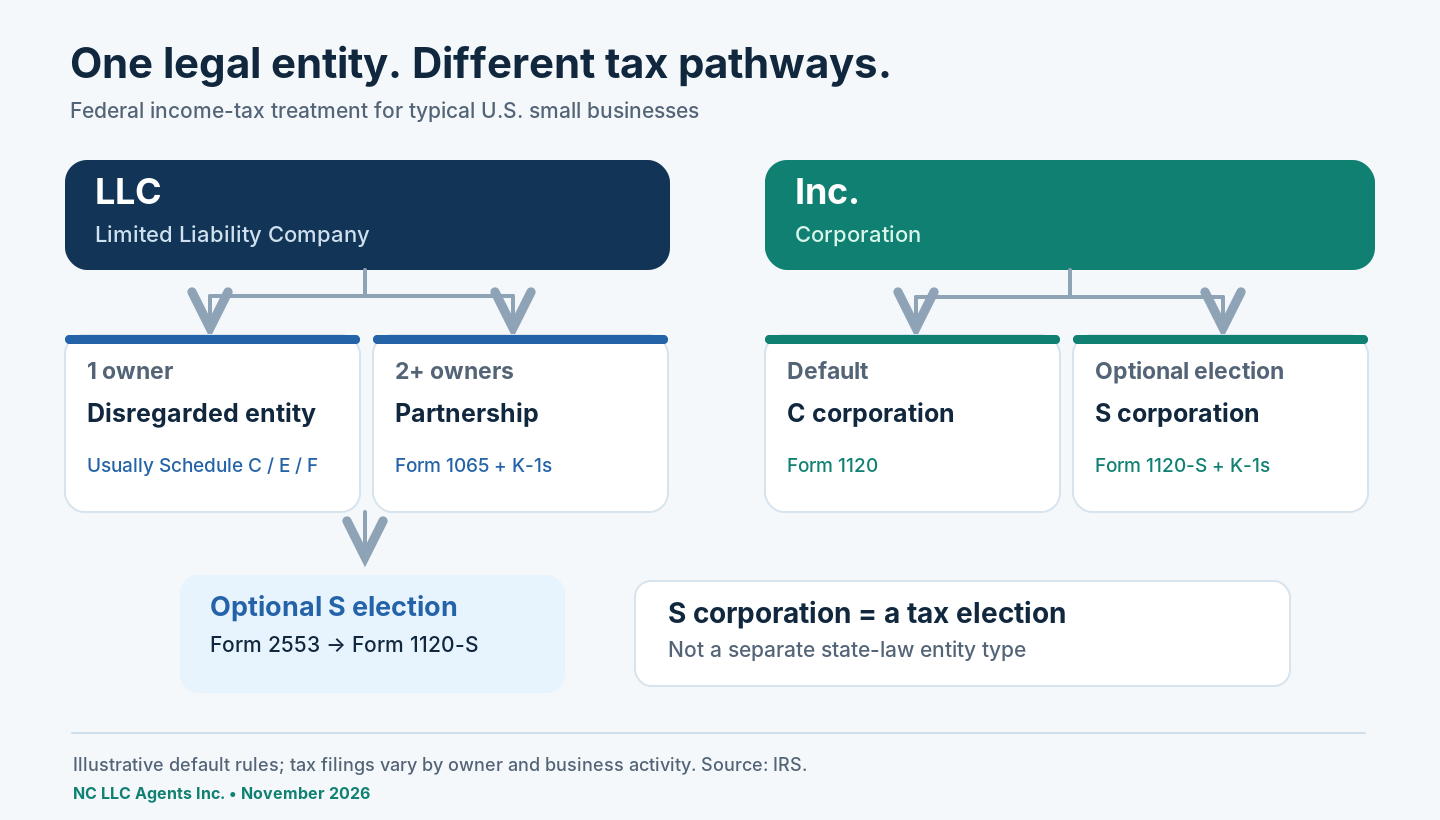
| Legal structure | Default federal income-tax status | Common federal reporting |
|---|---|---|
| Single-member LLC owned by an individual | Disregarded entity | Usually owner’s Form 1040 with Schedule C, E, or F, depending on activity |
| Multi-member LLC | Partnership | Form 1065 and Schedules K-1 |
| Inc. | C corporation | Form 1120 |
| Eligible LLC or Inc. electing S status | S corporation | Form 1120-S and Schedules K-1 |
A single-member LLC is still a legally separate LLC under state law even when disregarded for federal income tax purposes. Different rules can apply for employment and excise taxes. IRS: Single-member LLCs.
The $200 confusion: annual report versus franchise tax
North Carolina imposes two separate types of obligations that business owners often mix up:
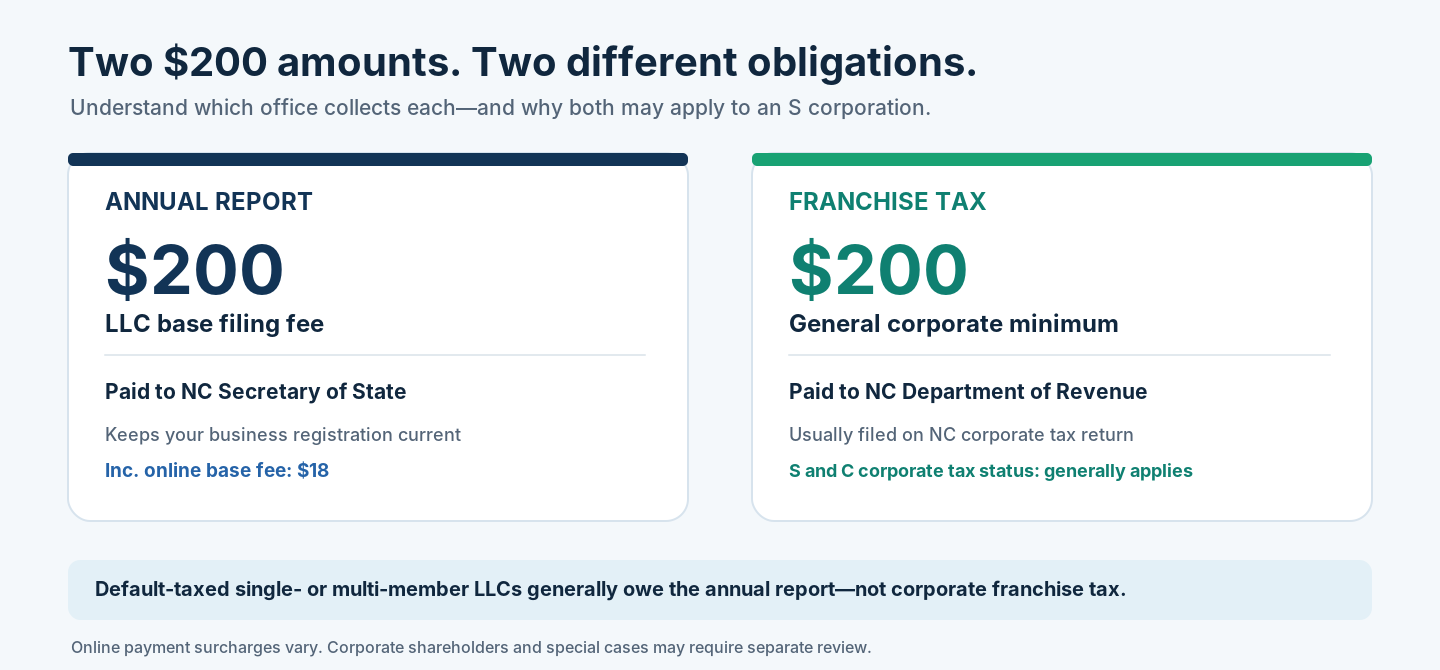
Annual report: Generally filed with the North Carolina Secretary of State to keep the entity’s registration and information current. The standard LLC annual report filing fee is $200, while a business corporation’s online base fee is $18. Payment-processing charges may apply.
Corporate franchise tax: Generally calculated and paid through the North Carolina Department of Revenue corporate tax return. It is a separate state tax, and qualifying corporations generally owe at least $200 even if they have a loss.
For 2026, the Secretary of State lists these annual report prices:
| Filing method | NC LLC | NC business corporation |
|---|---|---|
| Paper | $200 | $25 |
| Online + credit card fee | $203 | $21 |
| Online + ACH fee | $202 | $20 |
The online amounts include the currently published $3 credit-card fee or $2 ACH fee. An LLC’s first annual report is generally due April 15 of the year after formation, and April 15 each year thereafter. A corporation generally reports by the 15th day of the fourth month after its fiscal year ends. NC Secretary of State: Annual report due dates and fees.
The comparison that surprises many owners
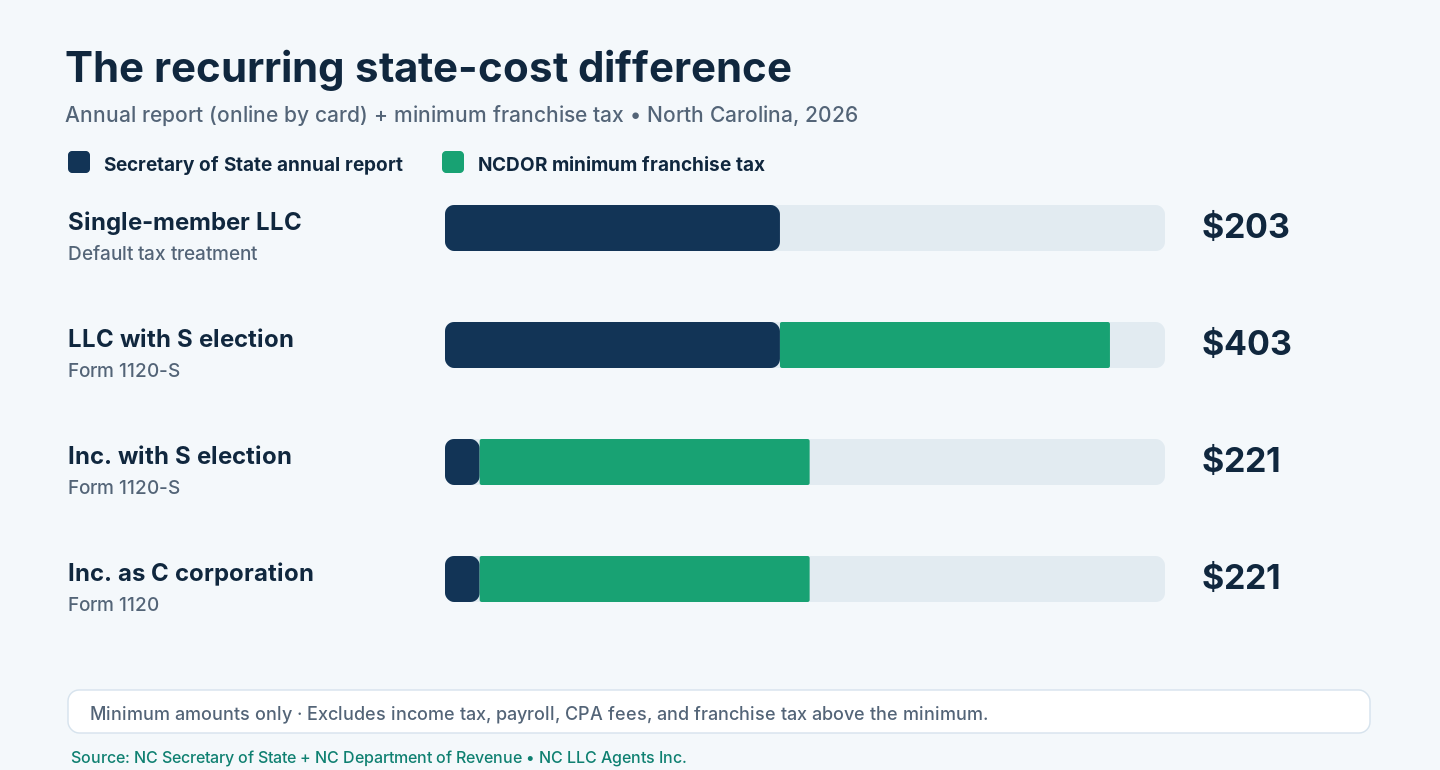
Online credit-card filing, assuming minimum franchise tax:
| NC entity / federal tax treatment | Annual report | Minimum NC franchise tax | Combined minimum |
|---|---|---|---|
| Single-member LLC, default | $203 | $0 | $203 |
| Two-member LLC, default partnership | $203 | $0 | $203 |
| LLC electing S corporation taxation | $203 | $200 | $403 |
| Inc. electing S corporation taxation | $21 | $200 | $221 |
| Inc. taxed as a C corporation | $21 | $200 | $221 |
What this table does not show: federal or state income tax, payroll taxes, accountant fees, registered-agent services, initial formation fees, local licenses, or franchise tax above the minimum. These are state filing-fee plus minimum-franchise-tax examples, not total annual tax costs. A qualifying corporate member of an otherwise noncorporate LLC can also have separate NC franchise-tax considerations.
Example 1: A brand-new one-owner junk removal LLC
An owner forms Fresh Start Junk Removal LLC, with one owner and default federal tax treatment. The company pays the North Carolina LLC annual report each year once due. It does not incur corporate franchise tax simply because it is an LLC. The individual owner typically reports business profit on Schedule C and may owe income tax and self-employment tax.
Illustrative NC annual report + franchise tax: $203 online by card.
Example 2: Two owners, same LLC filing fee
Two friends form a cleaning LLC owned 50/50. They have a partnership for federal income-tax purposes by default; they generally file Form 1065, provide K-1s, and file North Carolina partnership Form D-403 if required. Their company still pays the LLC annual report, but is generally not subject to corporate franchise tax solely because it has two members.
Illustrative NC annual report + franchise tax: $203 online by card—not $203 per member.
Example 3: A three-member family LLC
A mother and her two adult children each own one-third of a restaurant LLC. If they retain default partnership status, profits and losses are allocated under applicable partnership rules and reported on K-1s. Adding a third member does not turn the company into an S corporation and does not automatically add corporate franchise tax.
Illustrative NC annual report + franchise tax: $203 online by card, assuming no other special circumstance.
How a default single-member LLC pays federal taxes
Take a local junk removal company with these hypothetical annual figures:
| Item | Amount |
|---|---|
| Customer revenue | $150,000 |
| Deductible business expenses | ($90,000) |
| Net business profit | $60,000 |
The individual owner generally reports the $60,000 business profit on Schedule C (for this type of trade or business). The owner may owe federal and state income tax and federal self-employment tax; taking money out as an owner’s draw does not, by itself, reduce the reported profit. The LLC also remains responsible for its state annual report.
Example 4: What if the owner withdraws only $20,000? The owner doesn’t usually pay income tax only on the $20,000 draw. Tax treatment generally follows business profit and applicable adjustments, not just distributions.
Example 5: What if the LLC loses $10,000? It can still owe the NC annual report fee. The loss may affect the owner’s tax return subject to applicable limits. Default LLC treatment does not trigger the minimum corporate franchise tax.
Example 6: What if the LLC hires a CEO? A sole member can remain the 100% owner while another person acts as CEO or manager, without receiving an ownership interest. Duties and decision-making authority should be documented in the operating agreement or other company records. A paid CEO may create payroll obligations. North Carolina’s LLC law allows nonmember company officials and managers. NC law: G.S. 57D-3-20.
How a default two-member LLC pays federal taxes
Suppose two contractors form an LLC and their operating agreement provides for a 60/40 profit split.
Example 7: $100,000 in partnership profit
- Owner A generally receives a K-1 showing $60,000 of allocated income.
- Owner B generally receives a K-1 showing $40,000 of allocated income.
- The company generally files federal Form 1065 and, where applicable, NC Form D-403.
- The members report their shares on their own returns; self-employment tax rules depend on the nature of their participation and income.
- The company generally owes the regular NC LLC annual report fee, not corporate franchise tax solely for being multi-member.
Tax allocations must comply with partnership rules and the actual operating agreement; not every allocation is simply the ownership percentage.
What changes when an LLC elects S corporation taxation?
A qualifying LLC may file IRS Form 2553 to elect S corporation taxation without changing its legal name from “LLC” to “Inc.” In the typical qualifying LLC case, Form 2553 itself also accomplishes the deemed corporate classification election, so a separate Form 8832 generally is not required. IRS Publication 3402; Form 2553 instructions.
What usually changes:
- The entity files federal Form 1120-S rather than Schedule C or partnership Form 1065 for its business income.
- North Carolina S corporation reporting generally uses Form CD-401S.
- An owner who works for the business must receive reasonable W-2 compensation for services before taking non-wage shareholder distributions.
- Remaining qualifying pass-through profit is generally not subject to self-employment tax in the same way sole-proprietor business earnings are, although income taxes still apply.
- The company generally becomes subject to North Carolina’s corporate franchise tax, in addition to its LLC annual report.
Example 8: A growing junk removal company chooses S status
Suppose the business has $120,000 available before owner compensation and related employer payroll costs. An accountant determines that, based on the owner’s actual role and comparable pay, a $65,000 W-2 salary is reasonable.
| Illustrative item | Amount |
|---|---|
| Profit before owner compensation and related payroll costs | $120,000 |
| Example reasonable owner salary | ($65,000) |
| Balance before employer payroll tax and other adjustments | $55,000 |
The business owes payroll-related costs on salary; remaining pass-through profit may be eligible for different employment-tax treatment. This is not an estimate of tax savings, and $65,000 is not a universal reasonable salary. Actual reasonable compensation depends on duties, hours, local market pay, and other facts. IRS: S corporation compensation.
Example 9: S election with only $25,000 of annual profit. Payroll, separate business returns, accounting expenses, and the $200 minimum NC franchise tax can consume any potential employment-tax savings. S treatment is not automatically beneficial just because a business has one owner.
Is an Inc. better if you already know you want S corporation taxation?
Sometimes yes on recurring state fees, but not necessarily in overall legal simplicity.
Example 10: Two businesses, identical S corporation tax treatment
- Company A: Anywhere Services LLC, validly elected S treatment. Annual report online by card: $203. Minimum franchise tax: $200. Combined: $403.
- Company B: Anywhere Services Inc., validly elected S treatment. Annual report online by card: $21. Minimum franchise tax: $200. Combined: $221.
Difference: $182 per year under these assumptions. Over five years, that is $910 in these fees if the rates do not change.
Both companies generally file 1120-S federally and CD-401S in North Carolina. But corporations ordinarily have a board, directors/officers, corporate formalities, and stock records, while LLCs operate under a different governance framework. The fee difference is one factor; it doesn’t prove that forming an Inc. is always better.
Example 11: Start LLC now, elect S later. A founder can choose default LLC taxation while the company is small, then consider Form 2553 once business profit and owner compensation justify it. The LLC still remains an LLC under state law after the election. Have a CPA assess timing and whether the election is available.
What if an Inc. does not elect S status?
A North Carolina business corporation generally starts as a C corporation for federal tax purposes. A single shareholder does not change this.
Example 12: A one-shareholder C corporation. The corporation files Form 1120 and generally pays federal corporate income tax on taxable income; it also generally files NC Form CD-405, pays applicable NC corporate income tax, and owes franchise tax. If after-tax corporate earnings are distributed as taxable dividends, the shareholder can owe another layer of tax. This is the classic risk of double taxation.
For tax year 2026, the published North Carolina C corporation income tax rate is 2.00%; that is separate from the franchise tax. NCDOR rates.
North Carolina franchise tax is based on a tax base—not simply revenue
A common misconception is that the state charges a flat $200 every year on all S corporations, regardless of size. $200 is generally the minimum, not always the final amount.
For S corporations, NC generally charges $200 for the first $1 million of franchise tax base, then $1.50 per $1,000 of tax base above $1 million. For C corporations, the 2025-and-later rule is different: generally $1.50 per $1,000 of the tax base, minimum $200, with the portion attributable to the first $1 million capped at $500. The tax base uses statutory franchise-tax calculations—not raw annual revenue. NCDOR: franchise tax rates.
Example 13: S corp with $500,000 franchise-tax base. NC franchise tax is generally $200.
Example 14: S corp with $1,500,000 franchise-tax base. $200 for the first $1 million, plus ($500,000 ÷ $1,000 × $1.50) = $750, for $950 total.
Example 15: C corp with the same $1,500,000 base. Applying the C corporation formula gives $500 (first-million cap) + $750 for the excess, for $1,250 total. Other special rules can affect particular entities, including holding companies.
Example 16: S corporation reports a loss. Even a year with no taxable profit can leave the corporation responsible for at least $200 in franchise tax, plus its separate Secretary of State annual report.
Who files what, and where is franchise tax paid?
| Federal classification | Typical federal filing | Typical NC tax filing | NC franchise tax in normal case? |
|---|---|---|---|
| One-member LLC, disregarded | Owner’s Form 1040 + Schedule C/E/F | Owner’s individual return as applicable | No, not at LLC level merely for this status |
| Multi-member LLC, partnership | Form 1065 + K-1s | Form D-403 where required | No, not at LLC level merely for this status |
| LLC or Inc., S corporation | Form 1120-S + K-1s | Form CD-401S | Yes, generally $200 minimum |
| Inc. or corporate-taxed LLC, C corporation | Form 1120 | Form CD-405 | Yes, generally $200 minimum |
The NC franchise tax is typically computed and paid through the company’s NC corporate tax filing, not through the Secretary of State annual report and not directly on the owner’s Form 1040. If an accountant prepares the company’s CD-401S or CD-405, they ordinarily handle that calculation. The state annual report remains a separate filing.
Other scenarios owners should consider
Example 17: The owner later adds a partner. A default-taxed single-member LLC generally becomes a partnership for federal income-tax purposes when a second owner joins, unless a corporate classification/election is in place. That normally changes the filing to Form 1065/K-1s and may require a review of EIN and other tax consequences. It does not automatically cause franchise tax.
Example 18: A brother is CEO but not an owner. A sole member owns 100% of the LLC; the brother oversees operations as CEO. Management authority does not, by itself, convey equity. The CEO’s employment/compensation arrangement must be handled separately, and the operating agreement should state who may act for the company.
Example 19: The owner is not a U.S. tax resident. A U.S. LLC can generally have foreign owners, but an S corporation cannot have a nonresident alien individual as a shareholder. A wholly foreign-owned U.S. disregarded LLC can face special reporting—potentially Form 5472 attached to a pro forma Form 1120 when reportable related-party transactions occur. Do not assume “disregarded” means no filings. IRS Form 2553; IRS Form 5472.
Example 20: The company plans to raise venture funding. Traditional corporate stock structures, including C corporations, may be more appropriate for some investment scenarios. S corporations have restrictions on shareholder types, the number of shareholders, and stock classes. The best legal structure depends on investors and financing plans.
Example 21: You operate outside North Carolina. Forming an LLC in NC does not automatically satisfy registration or tax rules in every other state where the company is doing business. Other states may impose separate franchise taxes, filing fees, or foreign qualification requirements.
Frequently asked questions
Do all North Carolina LLCs pay the $200 annual report fee?
Most active NC LLCs must file the annual report and pay the $200 base fee (or the applicable electronic total), regardless of whether they have one member or several. The first report is generally due April 15 in the year after formation.
Does a two-member LLC owe $200 per owner?
No. The annual report is an entity filing, not a per-member fee. One ordinary two-member LLC typically has one LLC annual report.
Do two-member LLCs pay NC corporate franchise tax?
Usually not if the LLC is a default partnership owned by individuals. Special situations—particularly corporate owners—need separate review.
If I have one shareholder in an Inc., is it pass-through automatically?
No. A corporation is generally a C corporation by default. It needs a valid S election to receive S corporation treatment.
Can an LLC elect S corporation taxation later?
Yes, if eligible. A timely filed Form 2553 generally does this; special rules apply to the effective date and late elections.
Is franchise tax part of my regular personal tax return?
Not ordinarily. Corporate franchise tax is calculated as part of the North Carolina corporate tax return (for example, CD-401S or CD-405). The annual report is separately filed with the Secretary of State.
Can I avoid payroll by calling all the owner’s income distributions?
No. A shareholder-employee who works for an S corporation generally must be paid reasonable compensation for services before taking non-wage distributions.
Can a non-owner be CEO of my LLC or Inc.?
Yes. A CEO can be a non-owner. Clearly document the person’s authority; compensation for actual work can create employment and payroll obligations.
Is S corporation taxation always cheaper?
No. It may change employment-tax treatment, but brings payroll and separate-return costs and can add franchise tax to an LLC. Compare profit after reasonable compensation with the administrative burden before electing.
Which is better for a new one-owner junk removal company?
A single-member LLC with default taxation is often the simplest starting structure. If the owner expects to elect S treatment immediately, compare both an LLC and a corporation; the Inc. has lower NC annual report fees, though more traditional corporate governance. A CPA can help decide whether or when S treatment pays off.
Quick decision guide
- One owner, starting small, simple tax reporting preferred: Consider a default single-member LLC.
- Two or more owners wanting partnership flexibility: Consider a multi-member LLC with partnership taxation.
- Established profit beyond reasonable working-owner wages: Ask a CPA to model S corporation treatment.
- Already committed to an S election: Compare both LLC + S election and Inc. + S election; legal governance and NC recurring fees both matter.
- Planning complex investors or multiple equity classes: Discuss a corporate structure with legal and tax advisers.
The most important takeaway is simple: The $200 North Carolina LLC annual report fee is not the $200 minimum North Carolina corporate franchise tax. One is an entity-registration filing. The other is a tax obligation that generally depends on corporate tax status and a statutory tax base. Choosing wisely starts with understanding both.
Start your North Carolina business with clarity
NC LLC Agents Inc. helps entrepreneurs with North Carolina LLC and corporation formation, registered agent service, and state business compliance basics. We can help with the state formation process; for entity tax elections, reasonable compensation, and tax planning, consult a qualified tax professional.
Learn more: NC LLC Agents Inc.
Official sources and further reading
- IRS — Single-member LLCs
- IRS — Limited liability companies and default classifications
- IRS — Publication 3402, LLC taxation
- IRS — Form 2553 instructions and eligibility
- IRS — S corporation reasonable compensation
- NC Secretary of State — Annual report fees and due dates
- NC Department of Revenue — Corporate income and franchise tax rates
- NC Department of Revenue — S corporation Form CD-401S instructions
- NC Department of Revenue — Partnership Form D-403
- NC General Statutes — LLC managers and company officials, G.S. 57D-3-20
- IRS — Form 5472 and foreign-owned disregarded entities
Educational disclaimer: This guide is not legal, accounting, or tax advice. Rules and fees may change, and unusual situations (corporate owners, special entities, multistate operations, foreign ownership, elections, and tax credits) can produce different results. Verify current requirements with government agencies and a qualified CPA or tax attorney before filing.