By NC LLC Agents Inc. · Updated November 10, 2026 · 15 minute read · North Carolina business guide
Forming a North Carolina professional entity is not “file an LLC and add a P.” Board authorization, ownership limits, the permitted services, state registration and ongoing compliance each affect the result. This guide separates them.
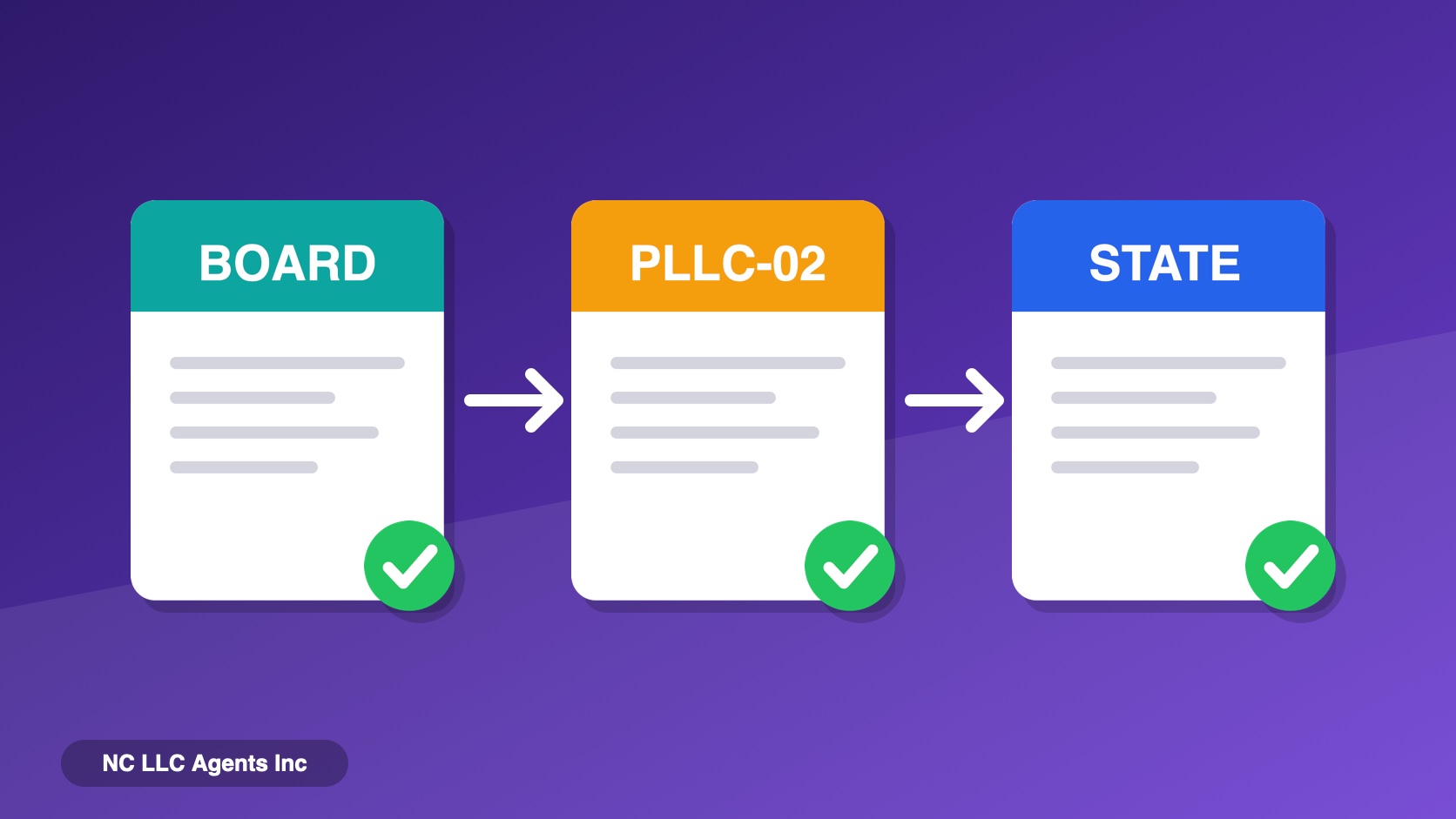
Short version: G.S. § 55B-2(6) decides which professions can use a PLLC. Your board certifies ownership, the Secretary of State files PLLC-02 for $125, and you keep two compliance calendars: one for the board, one for the state.
Who needs a PLLC in North Carolina?
G.S. § 55B-2(6) defines the services covered by the Professional Corporation Act, and G.S. § 57D-2-02 extends that structure to LLCs. A licensee offering a covered service through an LLC generally must meet the professional-entity rules. Covered services include architecture, law, public accounting, medicine and listed healthcare professions, dentistry, optometry, chiropractic, registered nursing, veterinary medicine, podiatry, psychology, marriage and family therapy, occupational therapy, speech-language pathology and audiology, clinical mental health counseling, engineering, land surveying, landscape architecture, clinical social work, geology, forestry and soil science.
Board regulated is not PLLC eligible. The Physical Therapy Board and the Board of Pharmacy both say their professions are not listed in Chapter 55B. An ordinary entity may fit, subject to each profession’s permit rules.
PLLC, PC and LLC compared
| Structure | Who typically uses it | Entity filing | Board action |
|---|---|---|---|
| PLLC | Covered professional services (Chapters 55B/57D) | PLLC-02 | Board certification; firm approval where required |
| PC / PA | Covered services using the corporate form | PC-05 | Board certification; entity registration |
| LLC | Other businesses, including licensed trades not covered by 55B | L-01 | May still need occupational or business permits |
“PLLC” is a state-law entity. An S corporation is a federal tax election, so any tax treatment is a separate question.
Who may own or manage a PLLC?
Owners usually must be licensed, but exceptions are profession-specific. G.S. § 55B-6 allows some non-licensee ownership in design professions and a separate non-CPA allowance for accounting firms. Neither “anyone can own 49%” nor “all owners must be licensed” is accurate.
Example: the Board of Examiners for Engineers and Surveyors generally requires at least two-thirds licensed ownership, with no more than one-third held by qualifying nonlicensed employees. That is not a universal formula.
Do not assume two disciplines can share one PLLC. G.S. § 55B-14 limits an entity to its authorized services and recognizes only certain combinations. At least one person signing the Articles must be a licensee of the applicable board, and the filing shows each signer’s capacity. See the Secretary of State requirements.
Step-by-step PLLC formation
Step 1: Define the exact professional services
Write a plain statement of what the practice will do. “Healthcare” is too vague to pick a board. In a multidisciplinary practice, identify each service and its licensed provider.
Step 2: Check each licensee
Verify status on the board’s website. Collect names as licensed, license numbers, ownership percentages and each person’s role.
Step 3: Confirm the ownership and management plan
List every member and manager. Do not draft an operating agreement that breaks a board’s ownership or control rule.
Step 4: Choose a compliant name
Search the state business database and use “Professional Limited Liability Company,” “PLLC” or “P.L.L.C.” Name approval is not approval to advertise under it. See name endings.
Step 5: Follow the board’s certification sequence
Some boards review proposed Articles and a proposed operating agreement before you file. The engineers and surveyors board, for example, asks for both with a $100 firm application, then wants the filed document back. State Bar Rule .0103(b) sets a separate process for lawyers. Do not assume one board’s sequence applies to another.
Step 6: Prepare Form PLLC-02
Include the compliant name, each signer’s name, address and capacity, a North Carolina registered agent and office, any principal office, the professional services, and the board certification. The operating agreement stays internal and is not filed.
Step 7: File and pay
Submit the documents with the $125 fee. Keep the stamped Articles and send them promptly if the board needs them to finalize a firm license.
Step 8: Set up the practice
Adopt an operating agreement, get an EIN, open a business account, and confirm insurance, tax registrations and any establishment or firm permits. See the LLC formation guide for the general steps.
Step 9: Confirm final status before opening
If the board issues a firm license after formation, confirm it is active before offering regulated services, and keep proof of licensure.
Secretary of State filings and fees
| Filing | Form | Base fee | Notes |
|---|---|---|---|
| New domestic PLLC | PLLC-02 | $125 | Board certification accompanies formation |
| Foreign PLLC authority | PLLC-01 | $250 | Home-state document required |
| Existing NC LLC to PLLC amendment | L-21 | $50 | Not a substitute for board approval |
| Domestic entity conversion to PLLC | PLLC-02A | $125 | A different transaction from L-21 |
| Annual report | Annual report | $200 paper | $203 online by card; $202 by ACH |
| Board application / renewal | Varies | Varies | Separate board requirements |
Checked November 10, 2026 on the state forms and annual report pages. The first annual report is due April 15 of the year after creation, so a PLLC created in November 2026 files by April 15, 2027. A registered agent’s fee is not the state’s annual report fee.
Licensing boards and NCAC chapters
Title 21 of the North Carolina Administrative Code holds most occupational board rules, and the State Bar sits in Title 27. A chapter number shows where a board’s rules live, not whether its profession can form a PLLC. Board names and chapters change, so check the current rules before relying on this list.
| Board / profession | NCAC chapter | Chapter 55B relationship |
|---|---|---|
| Architecture & Registered Interior Designers | 21 NCAC 02 | Covered: architecture; check interior-design scope |
| Barber and Electrolysis Examiners | 21 NCAC 06 | Not specifically listed under Chapter 55B |
| Certified Public Accountant Examiners | 21 NCAC 08 | Covered: public accountancy |
| Chiropractic Examiners | 21 NCAC 10 | Covered: chiropractic |
| Dental Examiners | 21 NCAC 16 | Covered: dentistry |
| Dietetics / Nutrition | 21 NCAC 17 | Not specifically listed under Chapter 55B |
| Examiners of Electrical Contractors | 21 NCAC 18B | Not specifically listed under Chapter 55B |
| Engineers and Surveyors | 21 NCAC 56 | Covered: engineering and land surveying |
| Funeral Service | 21 NCAC 34 | Not specifically listed under Chapter 55B |
| Geologists | 21 NCAC 21 | Covered: geology |
| Landscape Architects | 21 NCAC 26 | Covered: landscape architecture |
| Licensed Clinical Mental Health Counselors | 21 NCAC 53 | Covered: licensed clinical mental health counseling |
| Massage and Bodywork Therapy | 21 NCAC 30 | Not specifically listed under Chapter 55B |
| Medical Board | 21 NCAC 32 | Covered: medicine / specified related services |
| Nursing | 21 NCAC 36 | Covered: registered nursing as specified in statute |
| Occupational Therapy | 21 NCAC 38 | Covered: occupational therapy |
| Optometry | 21 NCAC 42 | Covered: optometry |
| Pharmacy | 21 NCAC 46 | Not Chapter 55B PLLC-eligible for pharmacy practice |
| Physical Therapy Examiners | 21 NCAC 48 | Not Chapter 55B PLLC-eligible for PT practice |
| Plumbing, Heating and Fire Sprinkler Contractors | 21 NCAC 50 | Not specifically listed under Chapter 55B |
| Podiatry Examiners | 21 NCAC 52 | Covered: podiatry |
| Psychology | 21 NCAC 54 | Covered: psychology |
| Refrigeration Examiners | 21 NCAC 60 | Not specifically listed under Chapter 55B |
| Social Work Certification & Licensure | 21 NCAC 63 | Covered: licensed clinical social workers (LCSWs) |
| Speech-Language Pathologists & Audiologists | 21 NCAC 64 | Covered: speech-language pathology and audiology |
| Veterinary Medical Board | 21 NCAC 66 | Covered: veterinary medicine |
| North Carolina State Bar (lawyers) | 27 NCAC 01 | Covered: law; State Bar has specific entity rules |
| Registration for Foresters | 21 NCAC 20 | Covered: forestry (additional Chapter 55B profession) |
| Marriage and Family Therapy Licensure Board | 21 NCAC 31 | Covered: marriage and family therapy (additional profession) |
| Licensing of Soil Scientists | 21 NCAC 69 | Covered: soil science (additional profession) |
Common reference errors: geologists are 21 NCAC 21 (32 is the Medical Board), landscape architects are 21 NCAC 26 (28 is landscape contractors), optometry is 21 NCAC 42 (40 is opticians), and electrical contractors are 21 NCAC 18B.
Real-world examples
Clinical mental health counselor
Counseling is listed in Chapter 55B. Confirm the board’s formation rules and get its certification for the PLLC filing. A generic LLC is not a shortcut.
Engineering firm with an employee-owner
The engineers and surveyors board lets a qualified nonlicensed employee own up to one-third. Licensed owners hold at least two-thirds.
Physical therapy clinic
The PT Board says physical therapy is not eligible for PLLC. An ordinary LLC may fit, while each therapist keeps an individual license.
Pharmacy
The Pharmacy Board says pharmacy practice is outside Chapter 55B. Separate pharmacy permits still apply.
Medical and counseling practice
G.S. § 55B-14 allows only specific combinations. Check the exact professions and ownership with every relevant board.
Law firm
The State Bar’s Rule .0103(b) requires materials before you file the Articles. Generic filing steps are not enough.
Already have an out-of-state LLC or PLLC?
A company formed elsewhere that wants to render regulated services in North Carolina may need to qualify as a foreign professional LLC with Form PLLC-01 ($250). The Secretary of State asks for a compliant name, a North Carolina registered agent and office, the professional services, board certification and a certificate of existence from the home state. Qualifying does not license out-of-state staff or guarantee that foreign ownership meets each board’s rules.
An existing North Carolina LLC becoming a PLLC is a different transaction. The state lists form L-21 for an amendment and PLLC-02A for specified conversions. Choose the form by the transaction, not the lowest fee.
Compliance after formation
| Obligation | Who handles it | What to track |
|---|---|---|
| Individual license | Licensing board | Renewal, continuing education, restrictions |
| Firm certification | Licensing board | Approval, renewal, ownership or manager changes |
| State annual report | Secretary of State | April 15 deadline; $200 base |
| Registered agent and office | Secretary of State / agent | A valid NC office and prompt service handling |
| Ownership transfers or new services | Board, counsel, sometimes the state | Approval may be needed first |
| EIN, taxes, insurance, local permits | IRS, tax agencies, insurers | Depends on the practice |
Updating the Secretary of State does not update your board, and the reverse is also true. Keep two calendars.
A PLLC does not excuse your own errors or misconduct. G.S. § 57D-2-02(b) preserves that liability while addressing responsibility for others’ professional acts. A registered office is for service of process and notices, not automatically your practice or records location. Read more in the registered agent guide.
Common PLLC mistakes
- Assuming every board license requires a PLLC. Check the Chapter 55B list first.
- Using an LLC for a covered service. The state may reject the filing.
- Filing before following the board’s instructions. Many boards want proposed documents first.
- Allowing owners or managers the board does not permit.
- Mixing professions without checking the allowed combinations.
- Confusing an individual license with a firm license.
- Using the registered office as the practice address.
- Missing the April 15 report or a board renewal. They are separate.
- Assuming a PLLC removes malpractice liability.
- Paying for an EIN as if it were an IRS fee. The IRS issues them free.
Frequently asked questions
Can two professionals from different disciplines form one PLLC?
Sometimes. G.S. § 55B-14 lists permitted combinations, and every relevant board’s rules apply.
Does a single-member PLLC still need board certification?
Yes. The state lists board certification as part of PLLC formation, even with one owner.
Can an owner not licensed in North Carolina hold an interest?
It depends on the profession, the percentage, the license elsewhere and any statutory or board exception. An out-of-state license does not automatically count.
When is the first annual report due?
For an entity created in 2026, the first report is due April 15, 2027. Check the entity record for changes.
Can a PLLC hold real estate or intellectual property?
A professional entity is limited to its authorized services, with allowances for ancillary activity and investments. A standard entity may suit unrelated holdings. Ask counsel first.
Need help with the North Carolina entity filing? We assist with formation coordination and registered agent service ($98/year). We do not replace your licensing board or authorize professional practice.
Official sources
- NC Secretary of State: Do I Need to File as a Professional Entity?
- NC Secretary of State: Domestic PLLC requirements
- NC Secretary of State: Professional LLC forms and fees
- NC Secretary of State: Foreign PLLC requirements
- NC Secretary of State: Maintaining registration
- NC Secretary of State: Annual report due dates and fees
- NC Secretary of State: Name endings
- N.C.G.S. § 55B-2
- N.C.G.S. § 55B-6
- N.C.G.S. § 55B-14
- N.C.G.S. § 57D-2-02
- NC Office of Administrative Hearings: Board chapter directory
- NC Board of Examiners for Engineers and Surveyors
- NC Board of Physical Therapy Examiners: Business entities memo
- NC Board of Pharmacy: General FAQs
- NC State Bar: Rule .0103
- IRS: Employer Identification Numbers
Educational disclaimer: This guide is not legal, tax, medical or professional-licensing advice. Fees and rules change. Verify current requirements with the North Carolina Secretary of State and your licensing board. A Secretary of State filing does not authorize anyone to practice without a license.